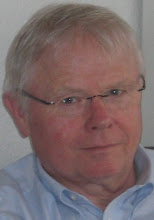
Saturday, July 25, 2009

A Farewell to John Updike


An author is only then dead for a real faithful reader when he has finished reading the last page of the latest published book. So for me the 25th of July 2009 is John Updike's date of death, not January 29th, the actual day.

There were still two new books to follow after John Updike had passed away. In March his poems Endpoint came out. In June My Father's Tears followed, a book with 18 short stories, whose last one The Full Glass I finished reading today, not without being rather touched.

Other than the poems whose final ones were written under the knowledge of the deadly threat that lung cancer posed to Updike's life, the short stories contain no hint that death is close at hand. Until the end the main character of every story (always clearly Updike himself, although disguised in different names and professions) talks rarely about old age and if, looks upon it with a humorous optimism, just as if life could go on for many more years.

In the last story Updike surprises the reader by choosing a rather practical profession for the narrator. He characterizes himself: My employment for 30 years, refinishing wood floors - and already the end of the long introducing sentence makes it clear, what to expect: […] has conditioned me against digging to deep. He is a craftsman, not an intellectual.

One can, of course, expect that this humbleness is a tricky way to get to other goals that Updike is pursuing. To my impression there has always been this particular one: to show his scepticism against all professional digging into people's souls. Not unlike his highly estimated model as an author, Vladimir Nabokov, who hated any kind of psychology, also Updike's art obviously grows from the knowledge that the human Psyche is too deep or at least too contradictory to be logic, an object of science.

When the craftsman at one stage of the narration does nevertheless dig something deep out of his soul (the secret relief that one of his former mistresses is dead and cannot go on to disturb his life from a distance) the idea is immediately withdrawn. There. You see why I am not given to introspection, to digging deep. Scratch the surface, and ugliness pops up.

So Updike consequentially keeps picturing rather mundane things that seemingly form a gentle stream on the surface, with little meaning. The truth, of course, is that there are many ways from here to reach deep into the secrets of human existence, and Updike knows all these ways.

The final scene describes the ritual of an average morning, shaving, taking pills and all. The glass of water that gives the story its title is raised to bring out an odd kind of toast. Updike here ironically pretends that he is not sure about what is in the drinkers soul. And so, half knowing and half not knowing, he ends his last story, his last book on earth:

If I can read the strange old guy’s mind aright, he is drinking a toast to the visible world, his impending disappearance from it be damned.

We will miss John Updike greatly.


Tuesday, July 14, 2009

Something Beautiful for Allah


When Mother Teresa, one of the last modern saints of the Catholic Church was, for the first time, asked to have her ministry filmed and reported about on television she was very reluctant. Only after an intervention from some Cardinal to whom the television people had turned for a favour she would finally give in and write them: “try to make the world conscious that it is never too late to do something beautiful for God.”

Something beautiful for God - the expression has inspired many people not only in the Christian world. People look for something beyond fulfilling a hard duty when they follow their religious principles, and beauty gives them a better direction than grey obligation. I am first of all writing this to encourage the work of my Muslim friend Nureddin Öztaş who already did a lot of beautiful things for his God, Allah. I know that he is worried about the lack of respect that a lot of Muslim people in the world receive. Maybe doing something beautiful for Allah is also a solution for this problem.

I have been connected to a wide range of young Muslims via the Internet, so I would secondly like to encourage all of them to do something beautiful for Allah. My wish is that they all find a personal way in showing the world the beautiful face of a life that is led under the assumption: there is a Living God. I know that many Muslims fear Islamophobia. To my opinion the best way to fight any negative feelings against Islam is to show the advantages of that faith, its beauty.

My friend Nureddin does something beautiful for God in, first of all, showing his personal friendliness to everybody around. Maybe this is the most important step to undertake. From Nureddin I learned that there is a very personal God in Islam and that you are asked to lead a life in his permanent presence. For Nureddin every daily human encounter carries within itself the chance to pass something on of the love and mercy that is the character of the ever-present God. Nureddin was born in Turkey and came to Germany when he was ten years old. He owns a pharmacy and he meets some hundred people every day. He tries to be friendly with them because he is aware of God’s presence.

When we first met I proudly told him about my own faith which I still think is very different from Nureddin’s: Christ became human so that his followers could live in the presence of a God-with-us. Nureddin replied gently that he liked the idea of such a God, even if he could not believe that God ever became man. In spite of our differences he agrees with every Christian that human life should be aware of the closeness of God and should mirror his presence in every possible situation.

Nureddin does a second beautiful thing for God. He engages in society projects. He is the president of a Ministry that gives lessons to school children after school, mainly children of immigrants with difficulties to get along in German schools. He and his friends are planning to have a complete new school open for Christian and Muslim children alike, a school where Islam is not taught but where nevertheless a spirit of respect and love shall reign, based on the principles of respect and love found in Nureddin’s religion. The plans for his school face a lot of objections in Germany because people here doubt that Muslims can run such a school without dark missionary ideas. From knowing Nureddin I am sure that people will soon find out that his school will be a good and decent place - a gift, brought by Muslim Germans to our society, something beautiful for God.

My third idea is maybe the most difficult: do something beautiful for God in finding freedom for others. There are only a few Muslim states in the world that have a working democracy. One of them is the Turkish, but Nureddin is nevertheless critical about the way in which the western world tries to impose, as he says, democracy on traditional Muslim societies. That is why he and I always disagree over the development in Iraq – I am glad for the Iraqis to have the chance for a living democracy, Nureddin is critical that it only means a forced-upon western style of life. Maybe we both are wrong, and that is why I propose a third way: to find a political system in which personal freedom is guaranteed and traditional values of Islam are guiding, reconciled with freedom.

My strong feeling is that right in this moment Mir Hossein Mousavi and his young followers in Iran are trying to find a way for exactly this kind of reconciliation. Wouldn't it be something beautiful for God, too, if they succeed? Showing the world the sympathetic face of Islam does not work without proving that all Muslims follow their faith in full freedom. Without freedom no real religion can ever live.

A personal word at the end: I got some new Muslim friends from following twitter. Search “iranelection” on twitter and you will get a whole bunch of people dedicated for freedom, for values, for Islam. Or type “marwa”, the first name of the Egyptian mother that was stabbed to death by a xenophobic madman in Dresden, Germany. You will find more young people, dedicated for dignity and non-violence. I am writing this not only for Nureddin but for all of you. Get out and do something beautiful for Allah. The world will see that beauty and love it – and love you.

The picture above contains words from Sura 1 and is taken from another blog.


Saturday, July 11, 2009

From Germany


Searching Twitter for #Marwa you will find a lot of disappointment expressed by Egyptians and others that mourn Marwa El-Sherbini. She was stabbed to death in Dresden Germany. Her death obviously is not remembered strongly enough by the world community and especially by us Germans.


I mourn Marwa’s awful death and all its painful circumstances. And I certainly understand those people's disappointment. But I would like to ease it at least in such a way that no further damage is done to the relation between Muslims and Christians.

A huge number of German citizens are Muslims (3.3 out of 82.1 Million says Wikipedia). Most of them are descendants of Turkish immigrants and live her in the second and third generation. According to polls they love their country and are content with their situation – sometimes even more than the native Germans.

Muslim women with headscarves are often seen in German streets. Marwa did not die because she wore one. Maybe with her scarf she had problems in finding certain jobs, as some reports say. But this would first of all be part of a general problem of someone who applies for a job wearing a regional dress of his home country – a turban, a long African gown, even leather trousers as the Bavarians, a German tribe, sometimes wear. Admittedly, a woman with a headscarf has the additional problem that Germans might see it as a sign of a forced-upon limitation of her rights as a woman. Nevertheless more and more young women here show their headscarves with a strong self-consciousness and find it increasingly accepted as a sign of faith and also as a sign of freedom from being exposed as a sexual object.

The German state was blamed for the week security in court. When the police arrived they shot at Marwa’s husband instead of the murderer. This is thought to be a result of secret racism: in a dangerous situation you aim at dark people first. Apart from seeing not much darkness in the photo above I know from my visits to court (my job demands them once in a while) that the policemen there are often young and inexperienced people. My guess is that the policeman aimed at nobody and shot in the floor or the air. It is difficult anyway to separate murderer and victim with a gunshot as long as they are closely together.

I will report in this blog about the results of investigations. Certainly they will show that the controls at the entrance of the court building were weak. In my hometown court there is an airport-like arch and an x-ray device for bags (where they always find my nail scissors and make me deposit them there). The murderer would not have got a knife through this.

Nobody can deny that there is hatred against foreigners in part of the population here. In Dresden’s State Parliament the right wing National Democratic Party (NPD) has seats. The murderer of Marwa obviously was one of those right wing nationalistic people (strange enough, he was a foreigner himself). Nevertheless painting Germany as a country with a strong tendency towards xenophobia and towards hate especially for Muslims does not only put a blame on my country that it does not deserve after giving 3.3. Million Muslims a home. Even worse, it darkens the hope of many people around the world that there will ever be freedom, equality and brotherhood, the ideals of the French Revolution from 1789, for all of us.

I have been following the events in Tehran via Twitter and cannot separate the people in Tehran, Dresden and Cairo. hat is why I say: If Germany, almost 65 years after the Hitler-nightmare and with 60 years of democracy is still a dark and wicked country – what hope do the people of Tehran have if they want to overcome their own nightmare and find new ways of a democracy for themselves? What positive example have they to foll0w?

My wish for peace between Muslims and Christians is embedded in the other urgent wish that new generations of Muslims will find new ways to unite their old faith with modern forms of government. The Turks successfully show the road, Lebanon is struggling, Iraq is (one may add inshallah) on a good way, others like Marwa’s Egypt still have long ways to go.

They all, we all need encouragement. I hope that my country will carry on to be one, even with Marwa's bloodstains in its ground that should not be forgotten.


Friday, July 3, 2009

Democracy and Faith


For my friend Nureddin.

One of our prominent German theologians is Eberhard Jüngel (photo) from Tübingen. He wrote* about the affinity between Christian faith and democracy beginning critically, saying that faith makes a difference between the union of believers and the political community. That is why faith sees church and state fundamentally different. Nevertheless Jüngel finally came to the conclusion that among the existing forms of government democracy is the one that fulfills Christian criterias for a good government best.

I thought about Jüngel these days when in many places of the world the question is discussed whether there is an affinity between another faith and democracy – the Muslim faith. The question here obviously has a much sharper edge. Imagine a representative of the German Muslims saying something similar like Jüngel on German TV. He would immediately be blamed for seeing democracy only as a sheltered garden where sharia can grow and overgrow in the end all other plants.

In spite of this you meet an increasing number of modern Muslims who are, in many ways like Jüngel, convinced that they can live their faith nowhere better than in the framework of a western style democracy. They do not want to rearrange this framework, because they live in states where many different religions meet, with atheism as a secret main religion included. A rearrangement according to the principles of a single religious idea would only lead to a destructive form of tyranny.

These modern followers of Mohammed that want to reconcile Islam and democracy have many adversaries. Prominent among them are the Christians whose mistrust in any form of an earthly kingdom of God is paradoxically rooted in the historical experience that there is almost no way to bring about such a kingdom. The Christian mistrust is mirrored by those among the Muslims who also have the image of a kingdom of God before their inner eye and do not want to sacrifice it for a democracy that is seen as atheistic.

There is right now a bloody borderline in Tehran that separates the fundamentalist rulers from their reformist adversaries who, under the leading of Mir Hossein Mousavi have that one goal: to reconcile the old faith with a modern form of government and lifestyle. Ahmadinejad is known to be among those who think reconciliation impossible (more details in a New York Times article). Odd enough among the hardest critics of the regime in Iran are also those that do not believe in reconciliation either. They occur in the Internet as radical Infidel Bloggers Alliance.

The question of reconciliation is also in Turkey far from being answered. The governing party of Prime Minister Erdogan believes in it, the opposition doubts it and takes the founder of modern Turkey, Kemal Atatürk as a witness. Apart from this scepticism there seems to be a traditional Turkish preoccupation against any form of Arabian government that makes it even harder to believe that there could ever be a working democracy in one of the Muslim main lands. This preoccupation lingers also in the mind of many of my fellow Germans and makes them half-hearted supporters if not critics of the democratic movement in Iraq. They would nevertheless not admit that, and would keep hidden behind their moral superiority over George Bush.

Also Israel has to ponder permanently whether Islam and democracy can go together. In the question of an independent Palestinian state the strongest forces of opposition arise from the doubts that this necessarily Muslim state could ever be democratic and thus reliable in its commitment to peace. The neighbours in Syria and Egypt and in some other countries obviously seem to give proof to the theory of both the radical conservatives and the radical progressives in the Near East that Islam and democracy do not fit.

Where are the friends and supporters of a possible reconciliation? In many personal meetings with modern Muslims I have seen a deep desire to be a natural part of what we call, a little simplifying the “Western World”. It is not western any more, it is rather an omnipresent area where people have the possibility of a worldwide exchange. The reign of this area has included more and more people in the last years and decades, and still more are waiting to be admitted.

I see Muslims everywhere that want to be part of this world, and see that, once they become actual members – as an example the Turks in Germany – show a high level of contentment with this world and the way they can lead their lives there.

These people want – also – to be religious. Many have to be religious in order to keep their inner voice of conscience audible in this noisy modern world full of voices. These people could be the heralds of a new reconciled way. You just have to open the door for them and give them a chance, in Iran, in Iraq, among the German Turks and everywhere.

*Eberhard Jüngel, Hat der christliche Glaube eine besondere Affinität zur Demokratie?

S. 111
..."der christliche Glaube die Gemeinschaft der glaubenden vom politischen Gemeinwesen und dementsprechend Kirche und Staat fundamental voneinander unterschieden weiß"

S. 377
"Unter den real existierenden Staatsformen ist die parlamentarische Demokratie diejenige, die den genannten Zumutungen mehr als jede andere entspricht."


Tuesday, June 30, 2009

New York Times' Analysis June 30


from today's New York Times

Bill Keller, the executive editor of The New York Times, who recently visited Iran and filed several stories on Iran’s contested vote and its aftermath is among the Times staffers answering readers’ questions.


Will Protest Movements Have an Effect?


Question: I would like to know if you think this green movement will lead to regime change?

Bill Keller: I’ll gladly defer to my colleagues who have spent far more time in Iran than I have, although I trust all of us will shy away from making predictions. One thing that struck me forcefully, though, as a novice watching the country move from pre-election euphoria to post-election outrage and repression, was that for Iranians themselves this month has been an eye-opening look behind a thick curtain. They have seen prominent figures in the modern history of Iran, veterans of the Islamic revolution, quarreling fiercely among themselves. They have seen the supreme leader, for the most part an unchallenged voice of civic and religious orthodoxy, openly (if, for the most part, subtly) challenged. They have seen their elections, which are designed to confer a gloss of popular legitimacy on theocratic power, derided as fraudulent. They have seen a significant cohort of their compatriots take to the streets. They have flocked to alternative information sources — foreign TV broadcasts, the Web, social networks.
The day before the election we interviewed a reformist presidential candidate, Mehdi Karroubi, and asked what would happen if the opposition lost. He said he couldn’t predict whether the popular energy unleashed by the electoral campaign would continue or whether the nation would “go into a coma.” Indeed, the educated middle class that provided much of the impetus for change does have a history of slipping into disenchantment and disengagement after defeat. Many of them deliberately sat out the election that brought Mahmoud Ahmadinejad to power in 2005. But I wonder whether an experience like the one Iran is going through now cannot help having an eventual corrosive effect on the regime itself.

Sunday, June 28, 2009

Mousavi's letter


Mousavi remains defiant

By MUHAMMAD SAHIMI in Los Angeles 28 June 2009
from: TEHRAN BUREAU

Iran’s Guardian Council — the Constitutional body that vets the candidates and certifies the validity of the elections — has formed a special committee to look into the irregularities of the presidential election, and to recount 10 percent of the votes. It has invited the candidates to introduce a special representative, so that the recounting can take place. But in a letter to the Guardian Council, Mir Hossein Mousavi, the main reformist candidate, insisted that the entire election process was fraught with numerous violations of important articles of Iran’s election laws and, therefore, there was no way to rectify the situation other than annulment of the election and holding a new one. In his letter, Mousavi divides all the violations of the government and the Interior Ministry, which supervises the elections, into four categories, stating:


Based on what I already informed the Council about [in Mr. Mousavi’s previous letters], the extent and depth of the unlawful acts [of the government] in four distinct categories, namely, The election campaigns, and what the government did prior to Election Day; The collection of the votes [on June 12] and their enumeration; Summarizing the results and announcing them [and], What has taken place after announcing the results, are such that there is no remedy for them other than annulment of the entire election and holding a new one. As examples, I point out certain violations and unlawful acts that are recognized by Article 33 of the laws of presidential elections as violations that influence the overall result of the elections and, therefore, leave no choice but annulment of the elections:

Explicit and widespread violation of Article 68 of the elction laws that forbids the use of public resources for, and the intervention of the cabinet members, senior officials, governor-generals, and managers in favor of the candidate of the establishment [President Mahmoud Ahmadinejad].

Violation of the neutrality of the Voice and Visage [Seda va Sima: National Iranian Radio and Television Network], and making unfounded accusations [against the reformist candidates] by that organ, the unlawful nature of some of which has also been confirmed by Iran’s Chief Justice [Ghorbanali Dorri Najafabadi], as well as widespread campaign and propaganda by governmental organizations, such as IRNA [Iran’s official news agency], newspapers, and websites in favor of the establishment’s candidate.

Widespread violations of Article 33 of the presidential election laws: buying votes by distributing the so-called “justice stocks and shares” and cash among the peasants. Threatening, as well as bribing by cash, members of the city councils, influential people, etc.

Lack of confidence in the ballot boxes being empty before they were sealed [before voting], disappearance of the voting forms and ballot boxes after voting, due to the fact that [our] monitors had been barred from being present at the voting places, as well as based on reports that have been received.

Denying people’s rights to vote by limiting the hours of voting, and many other violations, such as lack of voting forms at the voting locations.

Fraud in voting by not having enough voting forms at voting places, even though 12 million additional forms [on top of the 47 million needed for the number of eligible voters] had already been printed, and printing of an additional 2.5 million forms (and perhaps more) that had no official serial numbers had also been authorized by a member of the Council. Such violations can undoubtedly be proven by comparing the completed voting forms with the information in the Information Bank [that the government keeps of all the Iranian people].

“Recommendation” to people by the officials working at voting places for whom they should vote, and selecting such officials and monitors from amongst the ranks of the establishment candidate.

Intimidating the voters and supporters of the reformist candidates in the week before the election, and attacking their campaign headquarters and their supporters in the legal gathering and rallies around the country.

Setting many limitations for the [reformist] candidates’ monitors to attend the meetings of the executive committees [that supervise the elections], be present at the centers where the votes were collected and counted, as well as at a significant number of voting locations.

Cutting off, on the voting day, all means of mass communications, such as SMS and cell phones, which are used for monitoring the elections and reporting unlawful acts to my campaign headquarters, so that we could pursue the legal channels to stop them.

Collecting the votes in a way that could not be monitored, and announcing the results in an “engineered” way (while, even before announcing the results by the Interior Ministry, the websites that are linked with the government, the Sepaah [the Revolutionary Guards], and [the daily] Kayhan [the mouthpiece of the hard-liners] had already announced the results).

Widespread intervention in the elections by some parts of the armed forces prior and during the elections, which is against the explicit order of the Imam [Ayatollah Ruhollah Khomeini, who had forbidden the military from intervention in political affairs].

The existence of more 170 voting districts [out of a total of 368] in which the percentage of the votes cast was between 95% and 140% of the total number of eligible voters.

Attacking my [Mr. Mousavi’s] campaign headquarters throughout the country, shutting down my central campaign headquarter [in Tehran], and arresting the campaign chairman and its active members, which disrupted our work for collecting information and documents on the violations of the election law.

The letters continues to insist that the aforementioned violations of the election laws cannot be remedied by a partial recounting of the votes. It also casts doubt on whether the special committee can, in fact, be trusted:

All the above items indicate the existence of prior planning and organization for violating the election law. Since the Guardian Council has already stated that investigating some of the violations is beyond its authority, and because some of the violations were committed by the Interior Minister [Sadegh Mahsouli], other senior officials in the Ministry, and some members of the Guardian Council who violated the principle of neutrality, an impartial investigation of the violations cannot be done by the Guardian Council, as well as any committee that is appointed by the Council. Indeed, some members of the committee were not neutral in the elections, and have stated their positions before the investigation has been conducted and, therefore, cannot contribute to removing the public’s doubts about the elections.

Therefore, I [Mr. Mousavi] insist once again that the best way of addressing the issue and regaining the nation’s trust in the election process is by annulling the election and appointing a national adjudicating team that can be trusted by the public and its verdict can be accepted by it. Thus, I suggest that the issue should be referred to an independent legal team trusted by all the candidates and the religious leaders.

The special committee that the Guardian Council has formed consists of former Foreign Minister Dr. Ali Akbar Velayati; former speaker of the Majles (parliament) Gholamali Haddad Aadel; Chief Justice [and former Minister of Intelligence] Ghorbanali Dorri Najafabadi; Mohammad Hassan Aboutorabi, a conservative Majles deputy and a deputy Speaker; Mohammad Hassan Rahimiyan, Ayatollah Ali Khamenei’s special representative in the Shahid [martyr] Foundation; and Goudarz Eftekhar Jahromi, a legal scholar, university professor, and former member of the Guardian Council. Of these, Dr. Valayati has criticized Mr. Mousavi for calling for the annulment of the election. Mr. Haddad Aadel [whose daughter is married to a son of Ayatollah Khamenei] supported the candidacy of Mr. Ahmadinejad for a second term, and Mr. Rahimiyan has stated that, “those who could not get people’s votes [meaning Mr. Mousavi and Mr. Mahdi Karroubi, the second reformist candidate], instead of pursuing the matter through legal channels, resorted to alternative ways that have only made our enemies happy,” hence stating his opposition to mass demonstrations against the rigged elections. It should also be noted that Mr. Karroubi has stated that, in order for his representative to participate in the work of the special committee, two members of the committee who are not considered neutral must be replaced by others, but has not specified which two.

Copyright © 2009 Tehran Bureau

Friday, June 26, 2009

People in TwittIran


The heroes of my Twitter World are of course those that live and fight and suffer in Iran. They give their names quite openly, one can find many of them in a blog and follow them on Twitter.

Over a long day on Twitter-duty they sometimes share some personal things – an exam coming close, problems with computers, anger about some people they dislike. There is a revolution going on but nevertheless a day’s routine engrosses everybody. After a while you think that you know them personally.

Apart from theme there is a number of people standing by and watching, like me. It is a compassionate watch, especially with people like Omid Nouripor, a German with an Iranian background. He is member of our Parliament in Berlin, in a noisy party (Green) that I would normally not vote for. Nevertheless I like his heartfelt comments and re-tweets and the way he often adds a #prayforthem to it.

In Germany people with a “Migrationshintergrund” (migration background) are mainly welcomed by those parties tending to the left. Those to the right (which I normally vote for) rather keep them at a distance, which is a mistake and leaves me sometimes standing alone and freeze in conservative circles.

Every movement has at least one beauty to look at. In TwitterIran it is Lily Mazahery from Washington D.C. Her Twitter account had her picture taken from behind, showing her classic profile and her lovely shoulders. Unfortunately Twitter would overlay the shoulder part with text, so for a long time you only could guess how it looked. Only when the internet was slow the shoulders would appear for a second. That was the only time you would bless a slow internet.

Now she changed the size of the photo and you see shoulders and all immediately, but in a much smaller seize. To my fortunate readers here I proudly present the old, big shot.

Lily is in Wikipedia, she is reported about in the New York Times and sometimes she is on TV in the United States. She is a lawyer and a Human Rights Activist, as that profession is called. I am sure TwitterIran would make her the next Shabanu if she would only accept it (which I doubt, she doesn't sound too much monarchist).

Also on TV and active behind the political scene is my dear Joshua Trevino from California. In my imagination he is my closest ally and friend – a little older than the students, a conservative, a man in business, all like me. Nevertheless I disagree with his Conservativism in the same way I disagree with another American friend’s Liberalism.

Both stick to the crazy believe that every change of government in the USA invents the country completely new. The reality is that America is only gradually adjusted from time to time and in the meantime busy to keep all their trade partners on he losing side. I say that although I love almost no other country in the world more than the United States. If they only could give up borrowing money from the Chinese and changing it into foul derivative papers that make you bankrupt within weeks after you have faithfully bought it.

Honestly, this of course is exaggerated. I wish I could write half as good English as Joshua does. Sometimes he is so brilliant that I don’t even get his wit. Sorry for the small photo, his website with bigger photos is under attack right at the moment. He obviously has enemies. If it was the Iranian Secret Service it would surely make all of us proud.

I love you all!*


* After writing down this phrase I see that Michael Jackson used it, yes he passed away last night, and yes, it is almost forbidden in TwitterIran to let oneself be distracted by this event. Nevertheless also here every second tweet has MJ in it.